


Bai Shao for Muscle Tension and Digestion: When the Body Cannot Let Go

Updated: Jun 25
By Hansung Jang, L.Ac.· Lena Kim Acupuncture
Tight shoulders that never fully drop. An abdomen that feels pulled inward. Bowel movements that are infrequent, or never quite complete. What connects these? In classical herbal medicine, they may all point to the same underlying pattern — the body holding on too tightly to release on its own. Bai Shao (白芍, 작약), the dried root of white peony, is one of the most studied herbs for muscle tension and digestion in East Asian medicine, and it is the herb most closely associated with this presentation. For patients in Lake Forest, Newport Beach, and throughout Orange County who have been managing chronic tension without resolution, it may offer a different kind of answer.

Why Muscles Get Stuck — and Why Bai Shao (작약) May Help
Muscles work through a rhythm of contraction and release. When that rhythm is balanced, the body moves, rests, and recovers. When it is disrupted, the muscle stays contracted longer than it should. The connective tissue — the fibrous layer that wraps around and between muscles throughout the body — becomes guarded. Shoulders stay elevated. The abdomen stays pulled. Over time, this low-grade persistent tightening can become the body's default state: something the person stops noticing because it has simply always been there.
In classical herbal medicine, this pattern has a name: Ju Luan (拘攣, 구련) — a state in which muscles and connective tissue hold on too tightly and cannot release on their own.
Modern research has explored paeoniflorin, one of the major active compounds in Bai Shao, for its potential effects on pain signaling, smooth muscle activity, and inflammation-related pathways. These findings may help explain why Bai Shao has traditionally been used for cramping, abdominal tension, and pulling pain patterns. But in classical practice, Bai Shao is not chosen because of a single compound. It is chosen when the body shows a recognizable pattern: firmness, pulling tension, and an inability to release.
The tension accumulates until the body forgets what it felt like to be at rest. |
What the Abdomen Reveals

In classical herbal diagnosis, the abdomen is one of the most informative places to read what the body is doing beneath the surface — a practice called fukushin (복진, abdominal palpation).
The long muscle running down the center of the abdomen is particularly telling. When it is healthy, it feels soft and pliable under the hand. When it is not, it can feel taut, ropy, or cord-like — sometimes with distinct bands or nodules along its length. This finding, which classical texts describe as firmness with contracture, is one of the clearest signs that Bai Shao may be relevant to a formula.
This pattern may overlap with what some modern practitioners describe as myofascial tension or trigger point activity, though classical and modern systems approach these findings differently. In some patients, the same pattern can present as radiating discomfort, numbness, or a sense that a part of the body is not moving or responding the way it should.
The Gut Is Also Muscle
What makes Bai Shao clinically interesting is that its traditional use is not limited to skeletal muscle tension. The walls of the intestines are also made of muscle, and healthy digestion depends on a coordinated rhythm of contraction and release.
When that rhythm becomes constrained, bowel movements may become infrequent, incomplete, or difficult to fully evacuate. Some patients go two or three days between movements. Others feel the urge but cannot fully complete it. This is not always a matter of diet or hydration. Sometimes it is a matter of tone.
In these cases, Bai Shao is not being used as a laxative. It is used as part of a formula to address the overall pattern — and changes in bowel frequency, when they occur, are a sign the pattern is shifting.

How We Use Bai Shao at Lena Kim Acupuncture
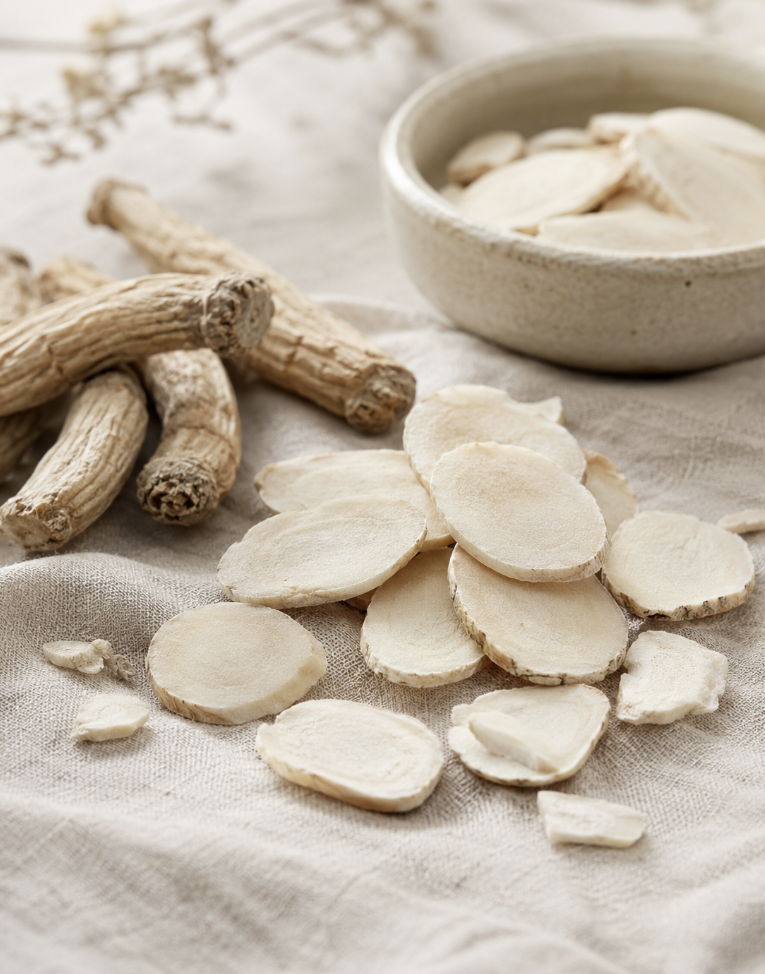
At our clinic, Bai Shao is never prescribed alone. It is used as a key ingredient within customized formulas selected based on each patient's specific pattern, constitution, and current health picture. Our practitioners assess through conversation, pulse, abdominal palpation, bowel patterns, sleep quality, stress load, and body type — looking not at the symptom in isolation but at the pattern driving it.
Two patients with chronic shoulder tension can require completely different formulas. One may have the classic Ju Luan presentation where Bai Shao belongs. Another may present with a depletion pattern — where the body is not holding too tightly but has simply run out of resources — requiring warming and nourishing herbs first. A third may have cold-fixed pain that calls for a different approach entirely.
The herb has to fit the pattern. The formula has to fit the person.
A Patient We Often See
A man in his late 30s came in with shoulder and neck tension that had persisted for several years. Massage helped temporarily, but the tension always returned within a few days. He also mentioned infrequent bowel movements — typically every two to three days — and a sense that his abdomen felt tight most of the time.
During our assessment, abdominal palpation revealed clear cord-like firmness along the rectus abdominis, with notable resistance in the upper epigastric area. His pulse was wiry and slightly rapid. This presentation was consistent with a Ju Luan pattern.
We prescribed a formula with Bai Shao as a primary ingredient, combined with herbs to support circulation and digestive tone, alongside weekly acupuncture targeting myofascial release points. By week three, he reported a noticeable softening in shoulder tension. By week six, bowel frequency had normalized and the abdominal tightness had largely resolved. He now comes in monthly for maintenance.
Safety and What to Expect
Bai Shao is generally well tolerated when properly prescribed — but it is not appropriate for every presentation or constitution.
In patients with weak or sensitive digestion — particularly those who are lean, easily bloated, or prone to loose stools — higher doses may cause mild abdominal discomfort or changes in bowel consistency. Dose adjustment is important in these cases, and our practitioners account for this during the initial intake.
Patients who are pregnant, trying to conceive, taking blood thinners, preparing for surgery, or managing chronic conditions should inform their practitioner before beginning any herbal treatment.
For patients with a clear Ju Luan pattern, changes in muscle tension and bowel regularity may begin within two to four weeks. More deeply established patterns typically require two to three months of consistent treatment to see lasting change.
 Jang's Clinical NoteWhen a body cannot let go of its tension, there is always a reason. Chronic stress. Inadequate sleep. Years of overwork. Old injuries. Emotional strain accumulated over time. The body records these things — sometimes as pain, sometimes as tightness, sometimes as digestive restriction. Bai Shao speaks to this kind of holding. But before I reach for the herb, I want to understand why the body is holding in the first place. Releasing the fascia without reading what is underneath it is only half the work. Hansung Jang, L.Ac, Associate Director Lena Kim Acupuncture - Lake Forest & Newport Beach, CA |
한국어 요약 (Korean Summary)
작약은 몸이 단단하게 뭉치고 스스로 긴장을 풀지 못할 때 고려하는 약입니다
어깨가 늘 뭉쳐 있고, 배가 자주 당기며, 변을 봐도 시원하지 않은 증상들은 따로 떨어진 문제가 아니라 하나의 흐름일 수 있습니다. 고전 한의학에서는 이를 구련(拘攣) — 근육과 결합조직이 과도하게 수축되어 스스로 풀리지 못하는 상태 — 으로 봅니다.
작약의 주요 성분 중 하나인 paeoniflorin은 통증 신호, 염증, 근육 기능과 관련해 연구되어 왔으며, 이는 작약이 전통적으로 경련, 복부 긴장, 배변 불편감에 사용되어 온 이유를 설명하는 데 도움을 줍니다.
복진(abdominal palpation)에서 복직근이 팽팽하고 줄처럼 만져질 때, 구련 패턴이 뚜렷할 때 작약이 처방에서 중요한 역할을 할 수 있습니다. 장벽 역시 근육이므로, 이 패턴은 변비나 불완전 배변과도 연결될 수 있습니다.
단, 모든 근육 긴장에 작약이 맞는 것은 아닙니다. 기력이 떨어진 허약 패턴이나 냉증에서 오는 통증에는 다른 방향의 처방이 먼저 필요합니다. 소화가 약하고 마른 체질에서는 고용량에서 복부 불편감이 올 수 있어 용량 조절이 중요합니다.
저희 클리닉에서는 맥진, 복진, 배변 패턴, 수면, 스트레스 수준을 종합하여 작약을 포함한 개인 맞춤 처방을 구성합니다. 임산부, 만성질환자, 혈액희석제 복용자는 반드시 면허가 있는 한의사 상담 후 복용하시기 바랍니다.
Ready to Explore a Personalized Herbal Approach?
Chronic tension, digestive restriction, and myofascial tightness that keeps coming back may share a common root. At Lena Kim Acupuncture, our practitioners build customized herbal formulas based on your individual pattern — not a one-size-fits-all supplement approach.
Lena Kim Acupuncture
📍 Lake Forest, Newport Beach, Irvine & Orange County, CA
📞 949-943-6161
We offer complimentary 15-minute consultations to discuss whether herbal medicine and acupuncture might be appropriate for your health concerns.
Medical Disclaimer: This article is for educational purposes only and does not constitute medical advice, diagnosis, or treatment. Always consult with a licensed healthcare provider before starting any new treatment. Individual results vary.


Comments